
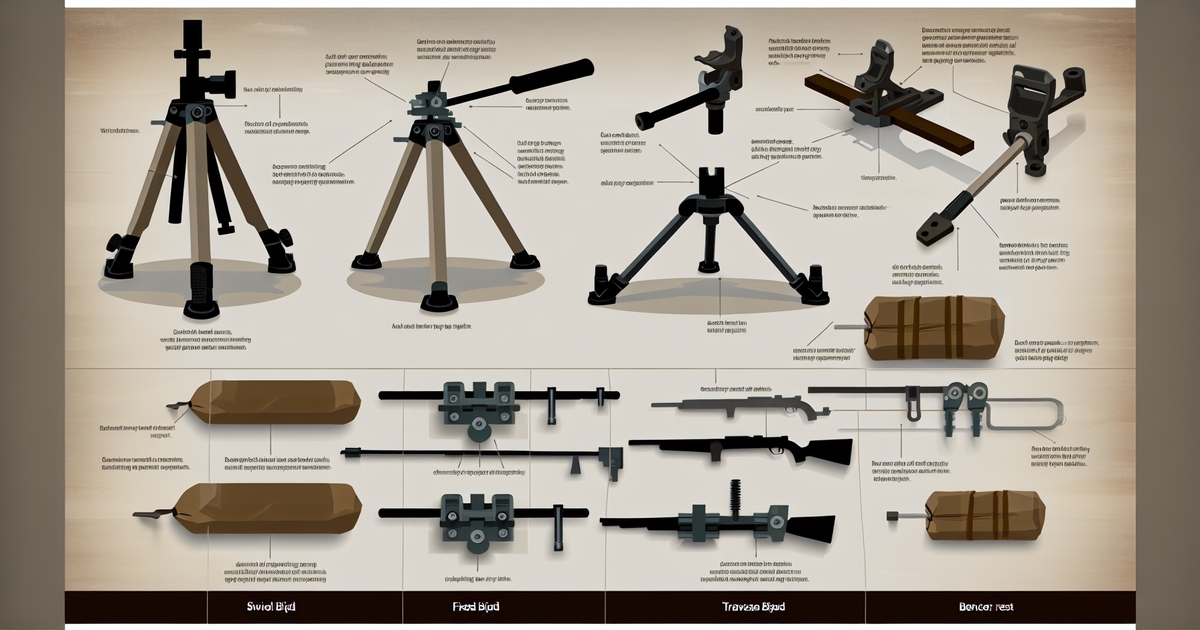
Rifle Bipods and Rests: Exploring Types and Considerations
Looking for stability and precision in your shooting experience? Rifle bipods and rests are the game-changers you’ve been searching for. Whether you’re a seasoned marksman or just starting out, these accessories can make all the difference. In this post, we’ll dive into everything you need to know about rifle bipods and rests – from their benefits in enhancing accuracy and reducing fatigue to the various types available on the market.
If you’re ready to elevate your shooting game, stay tuned as we explore how rifle bipods and rests can revolutionize your marksmanship. Get ready to discover which option best suits your needs and take a step towards achieving unparalleled control over your shots.
Key Takeaways
- Choose the right rifle support based on your shooting style and environment, considering factors such as stability, portability, and adjustability.
- Optics play a crucial role in enhancing rifle stability and accuracy, so invest in high-quality scopes and sights for improved performance.
- Ensure proper bipod height to maintain shooting accuracy and stability, especially when shooting from uneven or challenging terrains.
- Utilize laser range finders to enhance precision and increase shooting confidence, especially for long-range shooting scenarios.
- Select compatible ring mounts and accessories to optimize the setup of your rifle bipods and rests for improved functionality and performance.
- Prioritize customer service and support when purchasing rifle supports to ensure access to guidance, maintenance, and troubleshooting assistance.
Exploring Types of Rifle Bipods and Rests
Various Shooting Needs
Rifle bipods and rests come in various types to cater to different shooting needs. For instance, a hunter may require a lightweight, adjustable bipod for stalking game in rugged terrain. On the other hand, a competitive shooter might need a more stable and precise rest for long-range shooting competitions.
Some rifle support options are designed for quick deployment in dynamic environments, while others focus on maximizing stability for precision shooting. Understanding these differences is crucial when selecting the right bipod or rest for your specific shooting requirements.
Each type of rifle bipod and rest offers unique features that make it suitable for different applications. For example, some models feature adjustable legs with varying lengths to accommodate uneven surfaces, while others offer swiveling capabilities to track moving targets smoothly.
Specialized Bipods and Rests
Specialized rifle bipods and rests are available for specific shooting environments such as benchrest shooting or tactical operations. Benchrest shooters often opt for heavy-duty rests with fine-tuning adjustments to achieve unparalleled stability during target practice or competitions.
In contrast, tactical shooters may prefer compact yet durable bipods that can withstand harsh conditions encountered in military or law enforcement operations. These specialized supports are engineered to meet the rigorous demands of their respective applications, providing the necessary stability and functionality required in those scenarios.
When choosing between specialized rifle bipods and rests, it’s essential to consider factors such as weight, durability, adjustability, and compatibility with your firearm. Each type serves a distinct purpose based on the shooter’s intended use case—whether it’s precision marksmanship from a fixed position or rapid target engagement on the move.
Shooting Sticks vs. Bipods vs. Tripods
Contrasting Characteristics
Rifle bipods are designed with two legs to provide stability and support for shooting. They are commonly used in prone or bench shooting positions, offering a steady base for long-range accuracy. On the other hand, shooting sticks typically consist of three collapsible legs that can be adjusted to different heights, providing a versatile option for hunters who need to shoot from various positions and terrains.
Applications and Suitability
It’s essential to consider the specific requirements of each type. For instance, if you engage in precision target shooting or long-distance hunting in open fields or flat terrains, a bipod may be the ideal choice due to its stable platform that minimizes movement and enhances accuracy. Conversely, if your hunting endeavors involve navigating through rugged landscapes or shifting between standing and kneeling stances, shooting sticks offer greater adaptability by allowing quick adjustments according to the environment.
Stability and Versatility
Evaluating the stability and versatility offered by each type of rifle support is crucial when making an informed decision about which one best suits your needs. While bipods excel in providing steadfast support for precise aiming over extended periods without causing fatigue, they may have limitations. On the other hand, shooting sticks offer flexibility by accommodating changes in elevation or stance swiftly but may not provide as rock-solid stability as bipods during prolonged aiming sessions.
Key Considerations for Choosing Rifle Supports
Weight and Portability
When choosing rifle bipods and rests, it’s crucial to consider the weight of the support. A lightweight option is ideal for hunters who need to move swiftly in various terrains. The portability factor allows shooters to carry the support easily without adding significant bulk or weight to their gear. For instance, a carbon fiber bipod offers durability while keeping the overall weight low, making it suitable for long hunting trips.
Considering the portability of rifle supports is essential when shooting in diverse environments. Whether navigating through dense woods or trekking up mountains, a portable rifle rest ensures that shooters can maintain stability without being hindered by cumbersome equipment.
Adjustability and Stability
Another vital aspect when selecting rifle supports is their adjustability. An adjustable bipod or rest allows shooters to adapt quickly to different shooting positions and heights based on their surroundings and targets. This feature enables precision aiming during dynamic situations such as changing elevations or varying distances from potential game.
Moreover, prioritizing stability in rifle supports significantly impacts shooting performance. A stable platform minimizes movement and enhances accuracy, especially over extended periods of waiting or when dealing with windy conditions. For example, a bipod with independently adjustable legs provides stability on uneven ground by allowing each leg to adapt individually.
Durability and Compatibility
The durability of rifle supports directly influences their longevity under rigorous use conditions such as frequent hunting trips or extended range sessions. Opting for materials like aluminum alloy ensures that the bipod or rest can withstand substantial wear while maintaining structural integrity over time.
Furthermore, considering compatibility with both firearms and individual shooting preferences is paramount when choosing rifle supports. Different rifles may require specific mounting systems or adapters for seamless attachment of the support mechanism. Understanding these compatibility requirements prevents any inconvenience during setup at critical moments such as sighting game animals.
Bipod Height and Shooting Accuracy
Impact of Bipod Height on Stability
The bipod height plays a crucial role in maintaining stability and enhancing shooting accuracy. When the bipod is set at an appropriate height, it provides a solid foundation for the rifle, minimizing movement and sway. This directly impacts the shooter’s ability to maintain a steady aim and make precise shots. A higher bipod position can lead to instability due to increased center of gravity, while setting it too low might restrict maneuverability.
Finding the right bipod height ensures that the rifle remains steady during aiming and firing, especially when shooting from prone or bench positions. By adjusting the bipod legs to achieve an optimal height based on terrain conditions or shooting stance, shooters can significantly improve their overall performance.
Adjusting Bipod Height for Optimal Position
To optimize shooting position and target acquisition, shooters need to adjust their bipods according to various factors such as distance to target, wind conditions, and terrain features. For longer-range shots or when dealing with uneven ground surfaces, lowering the bipod can provide added stability by reducing potential wobble caused by elevation differences.
Conversely, raising the bipod may be beneficial when engaging targets at different heights or angles. This adjustment allows for better line of sight alignment without compromising stability. Shooters must experiment with different settings during practice sessions to determine which combination of elevation and stability works best for specific shooting scenarios.
Importance of Finding Balance Between Elevation and Stability
Balancing bipod elevation with stability is critical in achieving consistent shot placement while maintaining control over recoil forces. Too much emphasis on elevation might compromise overall steadiness, affecting accuracy under challenging conditions like strong winds or rapid target transitions.
On the other hand, prioritizing stability over elevation could limit flexibility in acquiring targets quickly across varying distances or terrains. Therefore, finding equilibrium between these two aspects is essential for shooters seeking improved marksmanship capabilities across diverse environments.
The Role of Optics in Rifle Stability
Enhancing Precision
Rifle bipods and rests play a crucial role in stabilizing the firearm during shooting. However, to further enhance stability and precision, shooters can leverage optics such as scopes and sights. These optical accessories allow for better target acquisition and aiming, leading to improved accuracy when combined with rifle supports.
Optics provide magnification capabilities that enable shooters to see their targets more clearly. This enhanced visibility allows for finer adjustments when aiming at the intended point of impact, resulting in greater precision during shooting. By integrating optics with rifle supports like bipods or rests, shooters can achieve consistent aim and improved accuracy across various shooting scenarios.
Complementing Rifle Supports
When using rifle bipods and rests, understanding how scopes and sights complement these accessories is essential for maximizing stability and precision. Scopes offer variable zoom levels that enable shooters to adapt to different distances effectively. This flexibility ensures that the shooter maintains a stable position while engaging targets at varying ranges.
Moreover, red dot sights provide quick target acquisition capabilities by superimposing an illuminated reticle onto the shooter’s field of view. When paired with rifle supports like bipods or rests, these sights allow for rapid yet precise aiming even in dynamic shooting situations where speed is crucial without compromising accuracy.
Consistent Aim Through Optical Accessories
The combination of rifle supports with high-quality optics contributes significantly to achieving consistent aim throughout shooting sessions. For instance, utilizing a sturdy bipod along with a scope equipped with an adjustable parallax feature enables shooters to maintain focus on the target regardless of distance variations or environmental factors such as wind movement.
Furthermore, incorporating specialized reticles within scopes can aid in compensating for bullet drop over long distances or accounting for crosswinds during outdoor shooting activities. These features empower shooters to consistently hit their intended targets while benefiting from the stability provided by rifle supports.
Enhancing Precision with Laser Range Finders
Precise Distance Estimation
Laser range finders are essential tools for improving distance estimation when shooting. By using a laser beam to measure the exact distance to a target, shooters can accurately gauge the required adjustments for elevation and windage. This enables them to make precise shots at varying distances, enhancing their overall accuracy.
Utilizing a laser range finder allows shooters to obtain accurate measurements of the distance between themselves and their targets. For example, when using rifle bipods and rests in combination with a laser range finder, shooters can easily determine the exact distance to their intended target. This information is crucial for making necessary adjustments to ensure an accurate shot.
Laser range finders play a pivotal role in helping marksmen achieve greater precision by providing them with reliable data on target distances. Integrating these devices into shooting setups significantly contributes to improving target acquisition and overall shooting performance.
Enhanced Shooting Accuracy
By integrating laser range finders with rifle supports such as bipods and rests, shooters can enhance their overall accuracy by ensuring that they have precise information about the distance to their targets before taking a shot. This integration eliminates guessworkAllowing marksmen to focus solely on making necessary adjustments based on actual measurements provided by the range finder.
The use of laser range finders in conjunction with rifle supports serves as an effective strategy for enhancing shooting accuracy across various scenarios. Whether engaging targets at long ranges or dealing with challenging environmental conditions, having access to accurate range measurements significantly improves marksmanship capabilities.
Importance of Ring Mounts in Rifle Setup
Significance of Secure Attachment
Rifle bipods and rests play a crucial role in stabilizing the firearm for accurate shooting. However, to ensure optimal performance, it’s equally important to pay attention to the secure attachment of optics to rifles. This is where ring mounts come into play. They provide a stable platform for mounting scopes or other optical accessories onto the rifle.
A secure attachment with high-quality ring mounts prevents any movement or shifting during recoil, ensuring that the optic remains perfectly aligned with the barrel. Without this stability, shooters may experience inconsistencies in their aim and struggle to maintain accuracy from shot to shot.
Quality ring mounts are designed to withstand the impact and vibrations generated by firing a rifle. The ability of these mounts to hold optics securely contributes significantly to overall shooting precision and consistency.
Selecting Appropriate Ring Mounts
When choosing ring mounts, it’s essential to consider factors such as material quality, design, and compatibility with both the rifle and optic being used. Opting for sturdy materials like aluminum or steel ensures durability while also minimizing weight added onto the firearm.
Furthermore, selecting appropriate height options for ring mounts is crucial in maintaining proper eye relief when using an optic. Improperly sized ring mounts can lead to discomfort during shooting due to awkward head positioning caused by inadequate eye relief.
The alignment between scope rings should be precisely matched with those on the base mount or rail of the rifle. Any misalignment can result in poor accuracy due to inconsistent zeroing adjustments required after every use.
Selecting Accessories for Rifle Bipods and Rests
Customizing Functionality
Rifle bipods and rests can be further customized and optimized with a range of accessories. These add-ons serve to enhance the functionality, adaptability, and versatility of the rifle supports. One popular accessory is the quick-detach system, which allows for swift attachment and removal of the bipod or rest. This feature enables shooters to easily transition between shooting positions or remove the support when not needed.
Another accessory that enhances functionality is the leveling device. This component ensures that the rifle remains perfectly level even on uneven terrain, thereby improving accuracy and precision during shooting. By adding these accessories to rifle bipods and rests, shooters can significantly improve their overall shooting experience by customizing their equipment to suit various scenarios.
Maximizing Adaptability
There are several compatible accessories available for rifle bipods and rests. For instance, some models offer interchangeable feet options such as rubberized or spiked feet. Rubberized feet provide stability on hard surfaces while spiked feet offer enhanced grip on softer terrain like grass or mud. Shooters can easily switch between these options based on the environment they are operating in.
Sling mounts are another useful accessory that adds versatility to rifle supports. By attaching a sling mount to a bipod or rest, shooters can conveniently carry their rifles over long distances without having to hold them at all times. This feature provides added comfort during extended hunting trips or shooting competitions where mobility is essential.
Customer Service and Support for Shooters
Importance of Reliable Customer Service
When choosing rifle bipods and rests, the importance of reliable customer service cannot be overstated. It’s crucial to have access to prompt assistance in case of any issues or inquiries. Imagine purchasing a rifle support product only to encounter problems with it, but there’s no one available to provide help or guidance.
Ensuring that the manufacturer offers reliable customer service can make a significant difference in the overall buying experience. From answering questions about product features to assisting with warranty claims, having dependable support is essential for shooters who rely on their equipment for accuracy and stability.
Evaluating Manufacturer Support and Warranty
Before making a purchase, it’s vital to evaluate the manufacturer’s support system and warranty policies. A reputable company will stand behind its products by offering comprehensive warranties that protect customers from manufacturing defects or malfunctions. This assurance provides peace of mind knowing that if anything goes wrong, the manufacturer will take care of it.
Furthermore, evaluating how accessible and knowledgeable the manufacturer’s support team is can also influence the decision-making process. For instance, some companies may offer online resources such as FAQs or video tutorials for troubleshooting common issues with rifle bipods and rests. This kind of proactive approach demonstrates a commitment to customer satisfaction beyond just selling products.
Accessing Knowledgeable Support
Shooters need access to knowledgeable support. Whether it’s understanding compatibility with different rifles or learning about proper maintenance techniques, having experts available can enhance the overall shooting experience.
An example would be reaching out to customer service representatives via email or phone for personalized assistance tailored to specific needs. If a shooter encounters challenges while setting up their rifle rest or has questions about optimizing its performance, being able to connect with knowledgeable individuals can make all the difference.
Summary
You’ve delved into the world of rifle bipods and rests, uncovering the various types available and the critical factors to consider when choosing the right support for your shooting needs. From comparing shooting sticks, bipods, and tripods to understanding the impact of optics and accessories on stability and precision, you’ve gained valuable insights into optimizing your rifle setup. Remember, finding the perfect rifle support is like finding the right dance partner – it’s all about balance, stability, and seamless coordination to hit your target with confidence.
Now that you’re equipped with this knowledge, go ahead and put it into action. Take the time to assess your shooting style, preferences, and environment before making a decision. Whether you’re a seasoned marksman or just starting out, the right rifle support can make all the difference in your shooting experience. Happy shooting!
Frequently Asked Questions
What are the main differences between shooting sticks, bipods, and tripods?
Shooting sticks are portable and lightweight but offer less stability. Bipods provide solid support for precision shooting and are adjustable. Tripods offer maximum stability but can be bulkier and heavier to carry.
How do I choose the right rifle support for my needs?
Consider factors like intended use (hunting vs. target shooting), terrain, weight, adjustability, and stability. Evaluate your shooting style and preferences to determine which type of support will best suit your needs.
What is the significance of bipod height in relation to shooting accuracy?
Bipod height plays a crucial role in achieving optimal shooting positions. Properly adjusting the bipod’s height ensures better control over recoil, improved sight alignment, reduced fatigue, and ultimately enhanced accuracy when aiming at targets.
How does optics contribute to rifle stability?
Quality optics aid in maintaining a steady aim by providing clear visibility of targets, especially over long distances or challenging lighting conditions. Optics with built-in stabilization features can further enhance rifle stability by compensating for movement or tremors during aiming.
Why is it important to select suitable accessories for rifle bipods and rests?
Choosing compatible accessories such as adapters, mounts, or slings enhances the functionality of your rifle supports while ensuring a secure fit. The right accessories not only improve convenience but also contribute to overall safety and performance during shooting activities.


